
Losing 1% body fat is defined as reducing your body fat percentage by one full point, which takes most people approximately 3–4 weeks under a consistent, moderate calorie deficit. A 500-calorie daily deficit produces roughly 1 pound of fat loss per week, and depending on your total body weight, that translates to about one percentage point of body fat per month. The clinical term for this process is “fat mass reduction,” and it differs from general weight loss because it targets adipose tissue specifically while preserving lean muscle. Your starting body fat percentage, activity level, protein intake, and resistance training habits all determine whether you hit that 3-week mark or stretch closer to 6 weeks.
How long does it take to lose 1% body fat?
Losing 1% body fat takes 3–6 weeks for most people, depending on body weight and how strictly they maintain their calorie deficit. A person weighing 180 pounds with 25% body fat carries 45 pounds of fat mass. Dropping that by 1% means losing 1.8 pounds of pure fat. At a sustainable pace of 0.5%–1.0% of total body weight lost per week, that 1.8-pound target takes roughly 2–4 weeks.
The math gets more nuanced when you factor in water weight and muscle. The scale often drops faster than actual fat leaves your body, especially in the first two weeks. Visible fat loss typically requires 4–8 weeks, with meaningful changes appearing over 2–4 months. That gap between what the scale shows and what your body composition actually reflects is exactly why tracking body fat percentage matters more than tracking scale weight alone.
How to calculate the calorie deficit to lose 1% body fat
One kilogram of fat contains approximately 7,700 calories. That means losing 0.5 kg of fat per week requires a daily deficit of roughly 550 calories. For most people, a 500-calorie daily deficit is the standard clinically studied pace, producing about 1 pound of fat loss per week.
The table below shows how different deficits translate into fat loss rates:
| Daily calorie deficit | Weekly fat loss (approx.) | Time to lose 1% body fat (180 lb person) |
|---|---|---|
| 250 calories | 0.5 lb | 7–8 weeks |
| 500 calories | 1.0 lb | 3–4 weeks |
| 750 calories | 1.5 lb | 2–3 weeks (muscle loss risk) |
A 750-calorie deficit pushes into risky territory. Exceeding that threshold increases the risk of muscle loss and metabolic adaptation, which slows future fat loss. The goal is not the fastest deficit. The goal is the largest deficit your body can sustain without breaking down muscle.
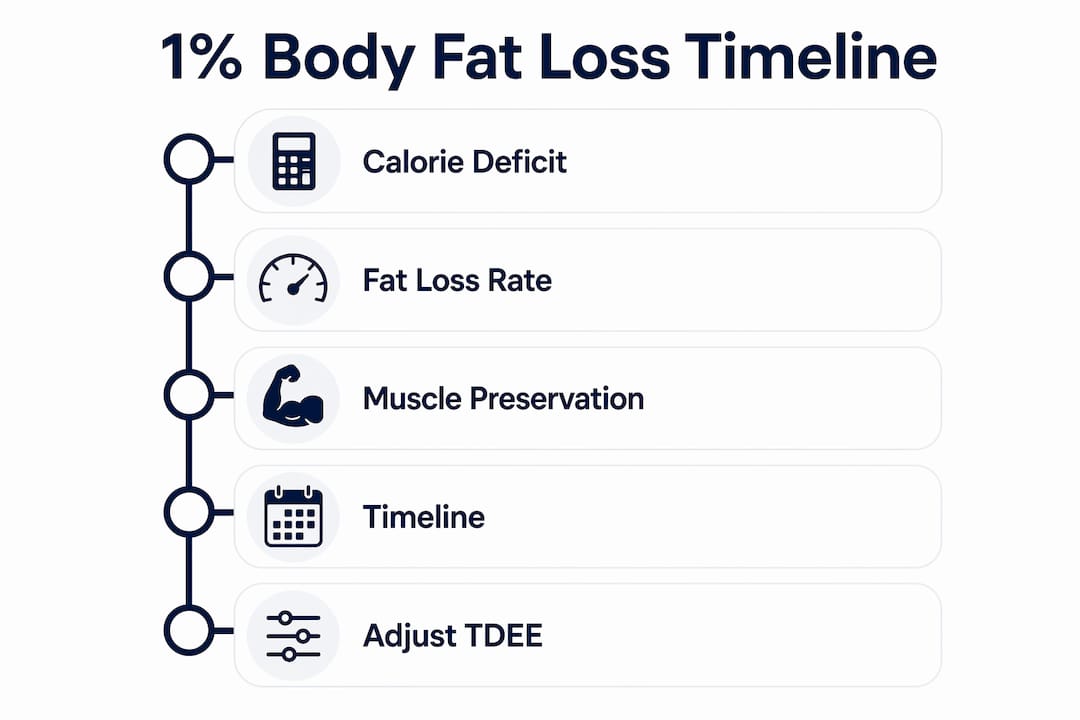
Your calorie deficit should also be a moving target. A deficit of 15%–28% of your TDEE (Total Daily Energy Expenditure), recalculated every 4–6 weeks, keeps fat loss progressing as your body weight drops. A fixed 500-calorie cut that worked at 200 pounds becomes less effective at 175 pounds.
Pro Tip: Recalculate your TDEE every 4–6 weeks and adjust your calorie target accordingly. Your maintenance calories drop as you lose weight, so the same deficit becomes smaller over time.
Why resistance training and protein matter for fat loss
Muscle is your metabolic engine. It burns more calories at rest than fat tissue does, so losing muscle during a calorie deficit directly reduces the number of calories your body burns each day. Resistance training at least twice per week can prevent nearly all muscle loss caused by calorie restriction alone. That single habit separates people who lose fat and keep it off from those who regain it within months.
Protein intake works alongside resistance training to protect lean mass. Consuming 1.8–2.2g of protein per kilogram of body weight during a calorie deficit gives your muscles the raw material to repair and maintain themselves. For a 180-pound (82 kg) person, that means 148–180 grams of protein daily. Most people eating in a deficit fall well short of that number.
Losing weight too quickly forces the body to break down both fat and muscle, reducing metabolic power and making long-term maintenance harder. The recommended pace of 1–2 pounds per week exists specifically to protect muscle tissue and keep metabolism intact.
Practical steps to protect muscle during fat loss:
- Lift weights at least twice per week, prioritizing compound movements like squats, deadlifts, and rows
- Hit your protein target daily, even on rest days
- Avoid dropping calories below 1,200 (women) or 1,500 (men) without medical supervision
- Spread protein across 3–4 meals rather than loading it into one sitting
- Sleep 7–9 hours per night, since poor sleep raises cortisol and accelerates muscle breakdown
Pro Tip: If you can only do one thing to protect muscle during a cut, make it protein. Hitting 1.8–2.2g per kg of body weight daily is more protective than any supplement on the market.
How individual factors affect your fat loss timeline
Starting body fat percentage changes everything. Someone at 35% body fat will lose fat faster in absolute terms than someone at 15%, because a larger fat mass creates more room for deficit-driven loss without touching muscle. The leaner you get, the harder your body fights to hold onto remaining fat stores.
Age, sex, and genetics also shift the timeline. Testosterone supports muscle retention during a deficit, which is why men often lose fat faster than women at the same calorie deficit. Metabolic adaptation, where the body reduces its energy output in response to sustained restriction, affects everyone but hits harder after age 40.
Key factors that influence how fast you lose 1% body fat:
- Starting body fat percentage: Higher starting fat means faster initial loss
- Total body weight: Heavier people have larger absolute fat stores, so 1% represents more pounds
- Activity level: More movement increases TDEE and allows a larger deficit without extreme restriction
- Genetics and hormones: Thyroid function, insulin sensitivity, and testosterone levels all affect fat mobilization
- Sleep and stress: Chronic stress raises cortisol, which promotes fat storage and muscle breakdown
Tracking body composition rather than scale weight gives you an accurate picture of progress. The scale can stay flat for two weeks while you lose fat and gain muscle simultaneously, a process called body recomposition. Body recomposition involves slow fat loss while maintaining or gaining muscle by eating near maintenance calories and prioritizing resistance training.
Step-by-step plan to lose 1% body fat sustainably
A clear plan removes the guesswork and keeps you moving in the right direction even when motivation dips.
- Calculate your TDEE. Use an online TDEE calculator based on your weight, height, age, and activity level. This is your maintenance calorie number.
- Set a moderate deficit. Subtract 500 calories from your TDEE as a starting point. This targets roughly 1 pound of fat loss per week.
- Set your protein target. Multiply your body weight in kilograms by 2.0 to get your daily protein goal in grams.
- Schedule resistance training. Block out at least two strength sessions per week. Three is better. Prioritize compound lifts.
- Track body composition, not just weight. Weigh yourself daily and average the week. Get a DEXA scan every 6–12 weeks for accurate fat percentage data.
- Reassess every 4–6 weeks. Recalculate TDEE, adjust calories if progress stalls, and confirm you are still hitting protein targets.
The table below compares common fat loss approaches by their effectiveness and sustainability:
| Method | Fat loss speed | Muscle preservation | Sustainability |
|---|---|---|---|
| Moderate deficit + resistance training | 1 lb/week | High | High |
| Aggressive deficit only | 2+ lbs/week | Low | Low |
| Cardio only, no strength work | Moderate | Low | Moderate |
| Body recomposition (near maintenance) | Slow | Very high | Very high |
The moderate deficit combined with resistance training wins on every metric that matters for long-term results.
Common mistakes that stall fat loss progress
Most fat loss stalls come from a handful of predictable errors, not from bad genetics or broken metabolism.
- Cutting calories too aggressively. Dropping below 1,200–1,500 calories triggers muscle breakdown and metabolic slowdown, making future fat loss harder.
- Skipping resistance training. Cardio burns calories but does not protect muscle. Without strength work, a significant portion of weight lost comes from lean mass.
- Confusing water weight with fat loss. The first 1–2 weeks of a deficit often show rapid scale drops from glycogen and water depletion, not fat. Do not adjust your plan based on early results alone.
- Ignoring protein targets. Low protein during a deficit is the fastest route to muscle catabolism and a weaker metabolism long-term.
- Making large changes all at once. Dropping 800 calories and adding five workout days in week one creates a shock the body resists. Gradual adjustments produce steadier results.
Patience is not passive. Every week you maintain your deficit and hit your protein target, you are building the metabolic foundation that makes fat loss permanent. The people who succeed long-term are not the ones who went hardest. They are the ones who stayed consistent the longest.
Pro Tip: If the scale has not moved in two weeks, check your protein intake before cutting more calories. Under-eating protein is the most common hidden reason fat loss stalls.
Key Takeaways
Losing 1% body fat takes 3–6 weeks for most people when combining a 500-calorie daily deficit, adequate protein at 1.8–2.2g per kilogram of body weight, and at least two resistance training sessions per week.
| Point | Details |
|---|---|
| Realistic timeline | Losing 1% body fat takes 3–6 weeks depending on starting weight and deficit adherence. |
| Calorie deficit target | A 500-calorie daily deficit produces roughly 1 pound of fat loss per week without muscle loss risk. |
| Protein is non-negotiable | Eat 1.8–2.2g of protein per kilogram of body weight daily to prevent muscle breakdown during a deficit. |
| Resistance training protects muscle | Lifting weights at least twice per week prevents nearly all muscle loss caused by calorie restriction. |
| Reassess every 4–6 weeks | Recalculate TDEE and adjust your calorie target as body weight drops to avoid plateaus. |
What I’ve learned from tracking fat loss the right way
The biggest mistake I see is treating fat loss as a weight loss problem. People obsess over the scale and ignore what is actually happening inside their body. You can lose 5 pounds of muscle and gain 3 pounds of fat and the scale will tell you that you made progress. That is not progress. That is a step backward.
The slow approach feels wrong because it does not feel like enough. A 500-calorie deficit seems modest when you want results fast. But the people who push to 1,000-calorie deficits almost always end up losing muscle, hitting a plateau, and regaining the weight within a year. The math catches up with them.
What actually works is boring: moderate deficit, high protein, consistent lifting, and accurate measurement. The measurement part is where most people cut corners. Tracking body fat percentage with a DEXA scan every couple of months tells you whether you are losing fat or losing muscle. That data changes how you adjust your plan. Without it, you are guessing.
Body recomposition is also underrated. Eating near maintenance while lifting consistently can shift your body composition significantly over 6–12 months, even without a meaningful calorie deficit. The scale barely moves, but your body fat percentage drops and your muscle mass increases. Most people never try this because it does not feel like “dieting.”
— Jan
Tracking fat loss with precision using Dexa
Knowing your calorie deficit is one thing. Knowing whether that deficit is actually removing fat, and not muscle, is another.

Dexa turns your DEXA scan PDF into an interactive dashboard that tracks body fat percentage, lean mass, and fat distribution over time. Instead of guessing whether your plan is working, you get a clear before-and-after picture of your actual body composition. The DEXA scan guides at dexa.report explain exactly what each metric means and how to use it to adjust your fat loss strategy. If you want to know what a DEXA scan measures and why it beats every other body fat tracking method, that resource covers it in full. Your data stays private, stored securely in the EU, and accessible only to you.
FAQ
How long does it take to lose 1% body fat?
Most people lose 1% body fat in 3–6 weeks by maintaining a 500-calorie daily deficit combined with resistance training and adequate protein intake. The exact timeline depends on starting body fat percentage, total body weight, and consistency.
Is losing 1 lb of fat per week safe?
Yes. A pace of 1–2 pounds per week is the clinically recommended rate for preserving muscle and metabolism. Faster loss risks breaking down lean mass and slowing your metabolic rate.
When will I see visible results from losing body fat?
Visible changes typically appear after 4–8 weeks, with more meaningful differences showing over 2–4 months. Starting body fat percentage and adherence to the plan are the two biggest factors.
How much protein do I need when losing body fat?
Protein intake of 1.8–2.2g per kilogram of body weight daily protects muscle during a calorie deficit. For a 180-pound person, that means roughly 148–180 grams of protein per day.
Why does my weight fluctuate even when I am losing fat?
Water retention, glycogen storage, and digestive content all cause daily scale fluctuations of 1–3 pounds. Tracking a weekly average and measuring body fat percentage separately gives a more accurate picture of actual fat loss progress.