Understanding the DEXA Scan: More Than Just Bone Density
When you're looking to understand your body's make-up beyond just what the bathroom scales tell you, a DEXA scan offers a detailed, scientific insight. Often associated primarily with bone health, a Dual-Energy X-ray Absorptiometry (DEXA) scan actually provides a comprehensive picture of your body composition, breaking down your bone mineral density, body fat, and lean mass with impressive accuracy.
What Exactly is a DEXA Scan?
A DEXA scan is a quick, non-invasive imaging test that uses a very low dose of X-rays to measure the density of your bones and the composition of your body. While it's a gold standard for assessing bone health, it's increasingly popular for those interested in fitness, weight management, and overall health, as it reveals much more than just bone density. It's a precise tool for understanding what your body is truly made of.
How Does a DEXA Scan Work?
During a DEXA scan, you lie comfortably on a scanning bed while a mechanical arm passes over your body. This arm emits two different X-ray beams, each at a different energy level. The difference in how these two energy beams are absorbed by various tissues (bone, fat, and lean tissue) allows the scanner's computer to differentiate between them. This process is entirely painless and typically takes only a few minutes. The data collected is then processed to generate detailed reports on your body composition.
What Does a DEXA Scan Measure? A Detailed Look at Your Results
So, what does a DEXA scan measure, exactly? It provides a wealth of information, offering a granular look at your internal physical make-up. Let's break down the key metrics you'll find in your dexa scan results.
Bone Mineral Density (BMD)
This is perhaps the most well-known measurement from a DEXA scan. Bone Mineral Density (BMD) indicates the strength and health of your bones. It's crucial for diagnosing conditions like osteoporosis (a condition that causes bones to become weak and brittle) and osteopenia (lower-than-normal bone density, a precursor to osteoporosis). Your BMD is usually measured at key sites like the hip and spine, as these are common areas for fractures.
Body Fat Percentage
Beyond simply knowing your weight, your body fat percentage is a critical indicator of health. A DEXA scan accurately measures the total amount of fat in your body and expresses it as a percentage of your total body weight. Unlike scales or callipers, DEXA provides a highly precise and consistent measurement, helping you understand your body fat levels in detail. Maintaining a healthy body fat percentage is important for overall well-being.
Lean Mass (Muscle Mass)
Lean mass refers to everything in your body that isn't fat - primarily muscle, but also organs, water, and connective tissues. A DEXA scan provides a detailed breakdown of your lean mass, often referred to as muscle mass in a fitness context. Knowing your lean mass is invaluable for tracking progress in strength training, understanding metabolic health, and ensuring you're building or maintaining muscle as you age. It's a key component of body composition tracking.
Visceral Fat: The "Hidden" Fat
One of the most important insights a DEXA scan can provide is the measurement of visceral fat. This is the fat stored deep within your abdominal cavity, surrounding your vital organs. Unlike subcutaneous fat (the fat just under your skin), high levels of visceral fat are associated with increased health risks. A DEXA scan can quantify this 'hidden' fat, offering a crucial data point for understanding metabolic health.
Regional Body Composition: Where Your Fat and Muscle Are
Beyond whole-body totals, a DEXA scan also provides a regional breakdown of your body composition. This means you'll see how much bone, fat, and lean mass you have in specific areas, such as your arms, legs, and trunk. This regional analysis can be incredibly useful for:
- Identifying imbalances: Noticing if one side of your body has significantly more muscle than the other.
- Targeting training: Understanding where you might be storing more fat or have less muscle, which can inform your exercise strategy.
- Tracking specific progress: Seeing how your arms or legs respond to a particular training programme.
Interpreting Your DEXA Scan Results
Once you have your dexa scan results, understanding what they mean is the next step. It's not just about the numbers themselves, but how they relate to healthy ranges and, crucially, how they change over time.
Understanding Your T-Scores and Z-Scores (for Bone Density)
For bone mineral density, your report will typically include T-scores and Z-scores:
- T-score: Compares your BMD to that of a healthy young adult of the same sex. A T-score of -1.0 or above is considered normal. Scores between -1.0 and -2.5 indicate osteopenia, and scores of -2.5 or lower indicate osteoporosis.
- Z-score: Compares your BMD to that of an average person of your age, sex, and ethnic background. This score is particularly useful for children, premenopausal women, and men under 50, as it helps identify potential underlying causes for low bone density.
What Do My Body Composition Numbers Mean for Me?
Your body fat percentage and lean mass numbers should be considered in the context of your age, sex, and activity level. There are general healthy ranges, but individual goals and health considerations play a big role. For instance, an athlete might naturally have a lower body fat percentage and higher lean mass than someone with a more sedentary lifestyle. It's about understanding what's healthy and sustainable for you.
The Importance of Trends Over Time
While a single DEXA scan provides a snapshot, the real power lies in body composition tracking over time. A single result tells you where you are now, but a series of scans reveals your progress, allowing you to see if your lifestyle choices are leading to the changes you desire. Are you gaining lean mass? Losing body fat? Maintaining bone density? Tracking these trends is key to understanding your long-term health journey.
Why Track Your Body Composition?
Understanding what a DEXA scan measures highlights why body composition tracking is so valuable for anyone serious about their health and fitness.
Beyond the Scales: A Clearer Picture of Progress
Traditional scales only tell you your total weight, which can be misleading. If you're exercising and building muscle, your weight might stay the same or even increase, even as you lose fat and improve your body composition. DEXA scans cut through this ambiguity, providing clear data on fat loss and muscle gain, giving you a much more accurate picture of your progress.
Setting Informed Health and Fitness Goals
With precise data on your body fat, lean mass, and even visceral fat, you can set much more informed and realistic health and fitness goals. Instead of just aiming to 'lose weight', you can aim to 'reduce body fat by a certain percentage' or 'increase lean muscle mass in your legs', making your objectives more tangible and measurable.
How Body Composition Changes with Lifestyle
Your body composition is dynamic and responds to your diet, exercise, and overall lifestyle. Tracking these changes with DEXA scans allows you to see the direct impact of your habits. This feedback can be incredibly motivating and help you fine-tune your approach to achieve optimal health outcomes.
What Does a DEXA Scan Measure and How Can dexa.report Help?
Understanding what a DEXA scan measures is the first step. The next is making that information work for you. That's where dexa.report comes in.
Easily Upload and Understand Your Scans
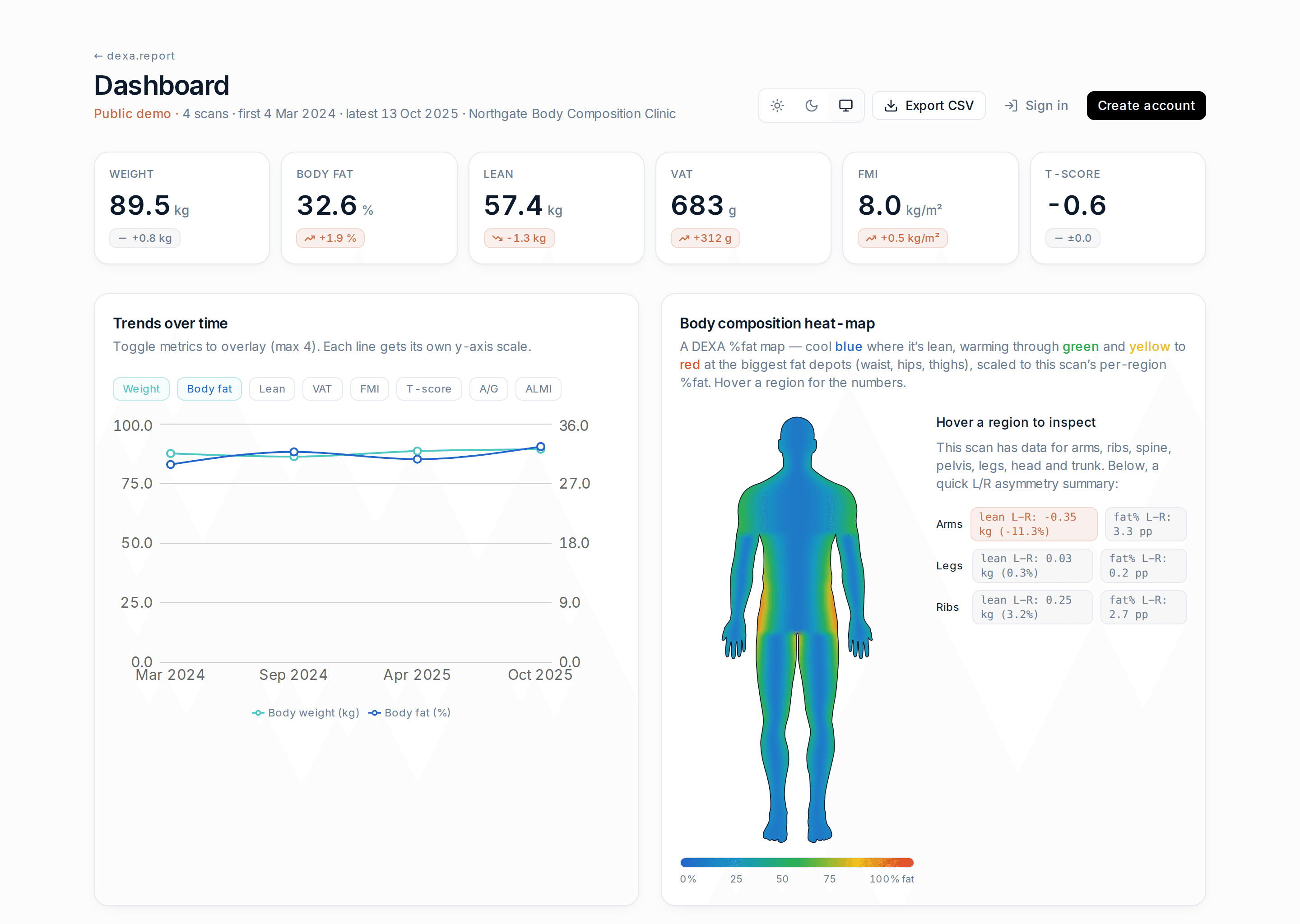
dexa.report simplifies the process of managing your dexa scan results. You can easily upload your DEXA scan PDFs, and our platform will parse the data, extracting all the key metrics - bone mineral density, body fat percentage, lean mass, and visceral fat - into an easy-to-understand format.
Visualise Your Body Composition Tracking Over Time
The real power of dexa.report is its ability to transform your individual scan results into a comprehensive, interactive longitudinal dashboard. This allows you to visualise your body composition tracking, seeing how every metric changes across scans over time. You can watch your progress unfold, identify trends, and gain deeper insights into your health journey. Drop your scan, parse the data, and start tracking your body's journey today with dexa.report.